BCI · Python · Real-time
Efferent Systems — pyBCI
Brain–computer interface toolkit built around a visual pipeline editor: wire EEG source to filter to model to application output, and watch each stage's latency as it runs.
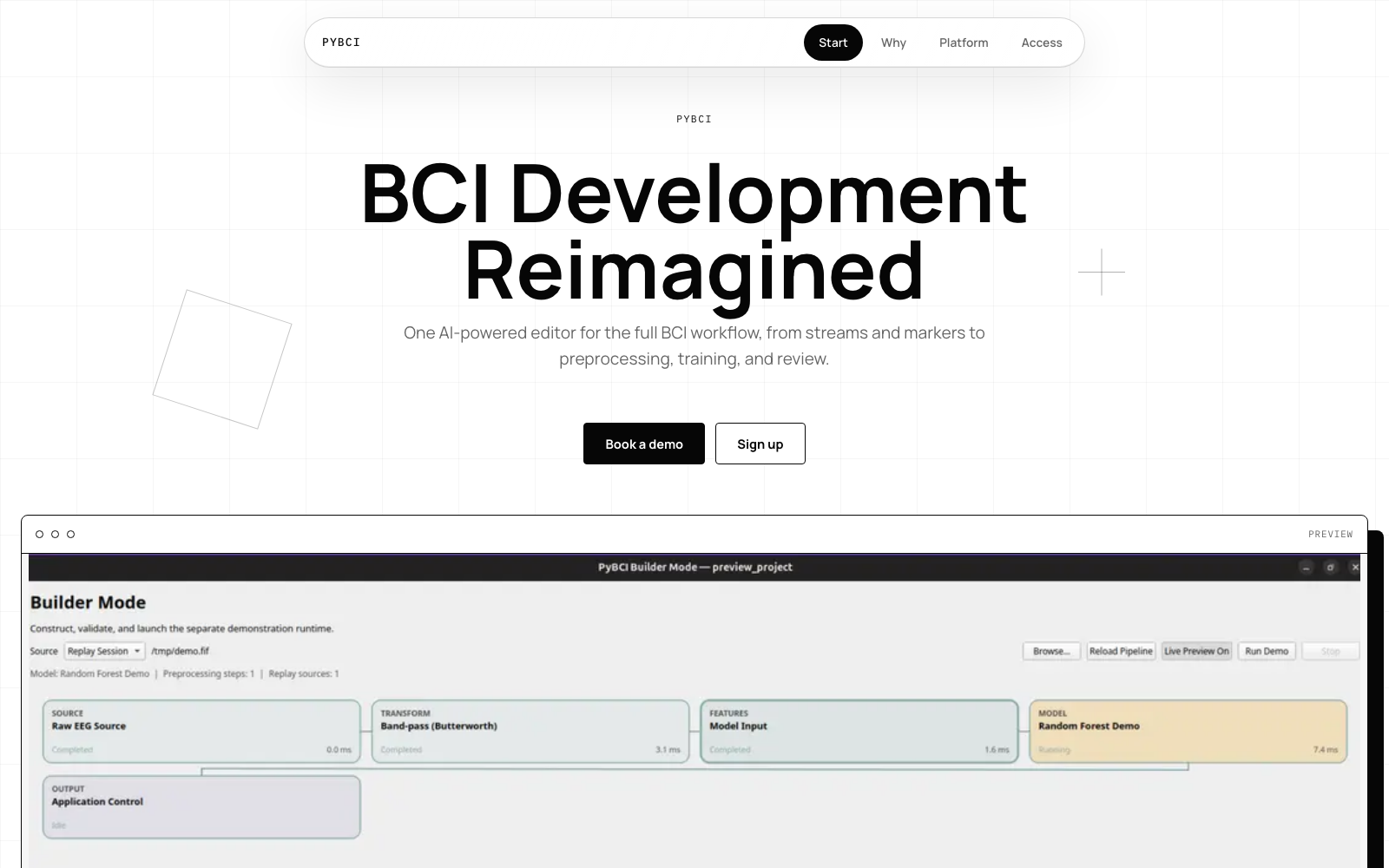
Live · pybci.dev
Overview
pyBCI is the software side of Efferent Systems: one editor covering the whole BCI workflow, from streams and markers through preprocessing, training and review. The premise is that BCI development is mostly plumbing — everyone rebuilds the same acquisition, filtering and windowing code before they get to the part they actually care about.
The centre of it is builder mode, where a pipeline is a chain of typed stages: a raw EEG source, a Butterworth band-pass transform, a feature stage feeding model input, a classifier, and an application-control output at the end. Each node shows its own state and the milliseconds it spent, so when the loop feels sluggish you can see which stage is responsible instead of guessing.
Sources can be a live stream or a replay from a recorded .fif file, which is the difference between iterating on a decoder in a few seconds and having to gel up an electrode cap every time you change a parameter.
The public site at pybci.dev is a Next.js 16 and React 19 app carrying the mission, docs, changelog and demo pages, with mailing-list signups persisted to Neon Postgres. Deeper architecture notes and benchmarks are still to come.